Why Do They Throw the Groom? History, Safety & Suit Tips
 Aug, 24 2026
Groom Toss Suit Protection Checker
Answer these questions about your outfit and venue to determine your "Suit Risk Score." The higher the score, the more precautions you need.
Component Breakdown
Recommended Actions
Picture this: The band hits a high note, the crowd roars, and suddenly your best man lifts you off the ground. For a split second, you're airborne, legs flailing, tie flying backward. It’s exhilarating, terrifying, and completely expected at most Western weddings. But why do we actually do it? Is it just for fun, or is there a deeper reason behind tossing the groom into the stratosphere?
The short answer? It’s a mix of ancient superstition, modern party culture, and a bit of chaotic joy. But if you’re wearing a custom-tailored three-piece suit, you probably care about more than just the history-you care about whether your lapels will survive the impact. Let’s break down the origins, the risks, and how to protect your investment while still having a blast.
The Ancient Roots of Tossing the Groom
Contrary to popular belief, this isn’t a new TikTok trend. The practice of lifting a partner into the air has roots in prehistoric rituals. Anthropologists suggest that early humans performed "jumping rites" to ensure fertility and health for the couple. By elevating the groom, communities symbolically connected him to the heavens, asking for blessings on the union.
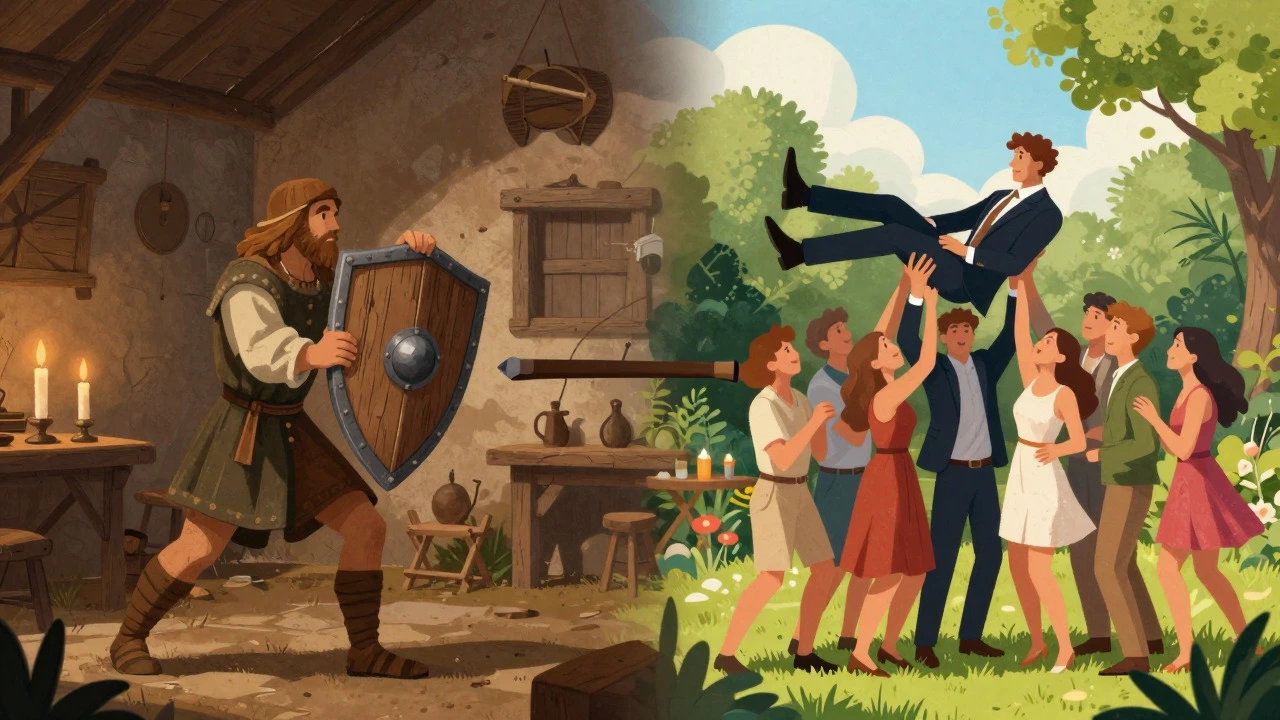
In medieval Europe, the tradition evolved differently. Instead of being thrown by friends, the groom was often lifted onto a shield or a horse. This served a practical purpose: it displayed the strength and status of the family. If you could lift your son-in-law without dropping him, you were a respectable household. Over time, as weddings became less about political alliances and more about personal celebration, the shield was replaced by strong arms, and the formal display turned into a spontaneous party moment.
Today, the act is less about status and more about shared energy. It’s a physical manifestation of the community’s support. When the entire group lifts the groom, it’s a collective "we’ve got you" moment before he steps into his new life role.
Safety First: How High Should You Go?
Here’s where romance meets physics. Most grooms are terrified of this part, not because they don’t want to be celebrated, but because they fear injury. And rightly so. A standard men's suit jacket weighs between 1.5 and 2.5 kilograms. Add the weight of the body, and you have a significant mass moving through the air.
So, what’s the safe height? Experts in event safety recommend keeping the throw under two meters (about six feet). Why? Because above that height, the risk of awkward landing increases dramatically. A soft landing on grass is one thing; a hard thud on concrete or tile is another. If you’re getting married in a ballroom with polished floors, consider limiting the throw to a gentle toss or a lift-and-hold rather than a full vertical launch.
Always brief your best man and the throwing crew beforehand. Assign specific roles: who holds the left arm, who supports the back, and who catches the legs. Chaos leads to dropped grooms. Coordination ensures a smooth flight path.
Protecting Your Groom Suit During the Throw
This is the part most grooms forget until it’s too late. You spent weeks choosing the perfect fabric, tailoring the fit, and selecting the right accessories. Now, you’re about to be tossed around like a ragdoll. How do you keep the groom suit looking pristine after the adrenaline rush?
First, check your buttons. Many modern suits use decorative buttons that aren’t meant to bear heavy load. If your jacket has functional buttons, great. If not, ask your tailor to add hidden snaps or hooks inside the front placket. This prevents the jacket from popping open when you’re inverted in mid-air.
Second, secure your tie. A long silk tie can become a whip in the wind. Consider using a tie clip or a bar pin. Not only does this look sharp, but it keeps the tie tucked safely against your chest, reducing drag and preventing it from snapping back into your face upon landing.
Third, watch out for the trousers. If you’re wearing suspenders, you’re in good shape-they stay put no matter how you land. If you’re relying on belt loops, make sure the belt is snug but not tight enough to cut off circulation during the lift. A loose belt can slide down, leaving you in an embarrassing spot when you hit the ground.
| Component | Risk Level | Mitigation Strategy |
|---|---|---|
| Jacket Buttons | High | Add internal snaps or hooks |
| Silk Tie | Medium | Use a tie clip or bar pin |
| Trousers/Belt | Low-Medium | Use suspenders or double-check belt fit |
| Pocket Square | Low | Ensure it’s folded tightly to avoid popping out |

Cultural Variations Around the World
While the Western world throws the groom, other cultures have their own versions of aerial celebration. In some parts of India, the groom is placed on a palanquin or carried on shoulders, emphasizing honor and respect rather than playful chaos. In Scandinavian countries, the tradition of "bride carrying" is more common, but the groom may still be lifted by friends in a lighter, less forceful manner.
In Australia, where this article is written, the tradition is firmly embedded in pub and backyard wedding culture. The throw is often accompanied by a chant or a song, turning it into a performance. It’s less about the height and more about the synchronized effort of the friend group. It’s a rite of passage that marks the transition from bachelor to husband, witnessed by everyone who matters.
If you’re planning a multicultural wedding, talk to your families about expectations. Some elders might view the throw as undignified, while younger relatives see it as essential fun. Finding a middle ground-perhaps a symbolic lift rather than a full toss-can satisfy both sides without ruining the vibe.
When to Skip the Throw (And What to Do Instead)
Not every wedding is suitable for a groom toss. Here are a few scenarios where you might want to rethink the plan:
- Formal Black-Tie Events: If you’re wearing a tuxedo with delicate satin lapels, a rough toss can crease the fabric permanently. Opt for a slow-motion lift instead.
- Small Intimate Weddings: With fewer than ten guests, the "crowd" effect is missing. The throw might feel awkward or unbalanced. Try a group hug or a toast instead.
- Outdoor Grass Venues: Wet grass is slippery. If it rained earlier in the day, the landing zone might be muddy. Protect your shoes and consider skipping the throw to avoid a slip-and-fall incident.
- Older Grooms: If you’re over 50, listen to your knees. A hard landing can trigger old injuries. A gentle lift is safer and just as celebratory.
Alternative celebrations include the "chair lift," where the groom sits on a chair while friends lift the chair itself. This reduces the risk of dropping him directly onto the ground. Another option is the "balloon pop," where the groom stands on a platform of balloons that burst upon landing, creating a visual spectacle without the physical strain.
Preparing for the Moment: A Checklist
To ensure everything goes smoothly, run through this quick checklist before the reception starts:
- Brief the Crew: Identify four to six strong, coordinated friends. Explain the hand positions clearly.
- Check the Floor: Ensure the landing area is clear of tables, chairs, and glassware. Concrete is hard; carpet is better.
- Secure Accessories: Clip your tie, button your jacket, and adjust your belt.
- Agree on a Signal: Decide when the throw happens. Usually, it’s after the first dance or during a high-energy song.
- Have a Spotter Ready: One person should stand slightly behind the groom to catch him if the lift wobbles.
Remember, the goal is celebration, not competition. You don’t need to go higher than the last guy. You just need to have a memorable, safe, and joyful moment with the people who love you.
Frequently Asked Questions
Is it dangerous to throw the groom?
It can be risky if done incorrectly. Keep the throw under two meters, ensure a soft landing surface, and use a coordinated team of at least four people. Avoid throwing over heads or near fragile objects.
Will my suit get ruined if I’m thrown?
Probably not, if you take precautions. Secure your tie with a clip, add internal snaps to your jacket, and ensure your trousers are well-fitted. Minor wrinkles can be steamed later, but popped buttons or broken ties are harder to fix.
What if the groom doesn’t want to be thrown?
Listen to him! The tradition is optional. If he’s uncomfortable, suggest alternatives like a chair lift, a group photo, or a simple toast. The celebration should reflect the couple’s preferences, not just social pressure.
Who usually throws the groom?
Typically, the groomsmen and close male friends handle the throw. However, any group of strong, willing participants can join in. The key is coordination, not gender.
Does the bride get thrown too?
Sometimes, yes. In many modern weddings, both partners are lifted or thrown as a symbol of equal partnership. It’s a nice touch to show unity and shared joy.