What Size Diamond Can You Get for $20,000? A Realistic Guide
 Apr, 4 2026
Diamond Budget & Size Estimator
Estimated Result
A 1.9ct natural diamond is often significantly cheaper than a 2.0ct stone despite looking nearly identical.
Quick Guide: What Your $20,000 Actually Buys
- Natural Diamonds: Typically ranges from 1.5 to 2.5 carats, depending heavily on color and clarity.
- Lab-Grown Diamonds: Can easily reach 4 to 6 carats with top-tier quality.
- The Trade-off: To get a larger natural stone, you'll likely need to sacrifice color (going for G or H) or clarity (dropping to VS2 or SI1).
Understanding the Carat Weight Game
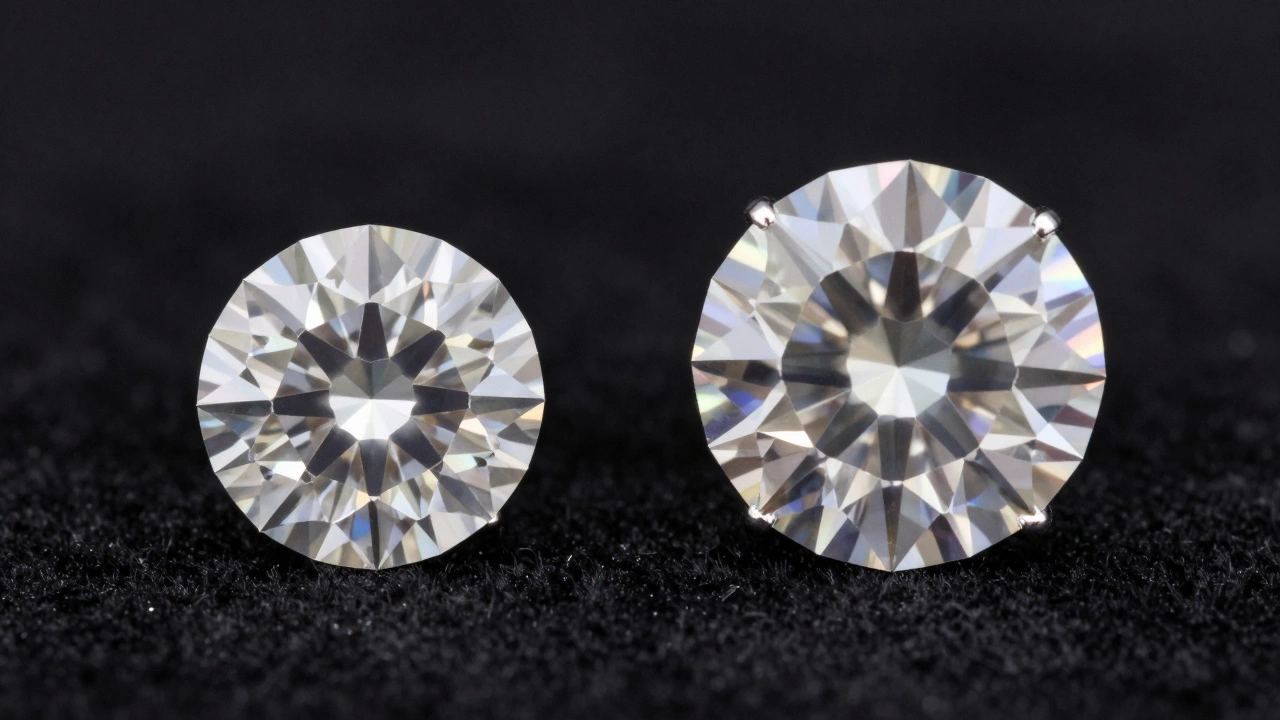
First, let's get the basics straight. When people ask about diamond size for 20000, they are usually talking about Carat Weight. A carat is a measure of weight, not physical size. While a 2-carat diamond is generally larger than a 1-carat diamond, the actual diameter depends on the Cut of the stone.
A poorly cut diamond "leaks" light, making it look smaller and dimmer. A well-cut stone reflects light perfectly, making it appear larger and more brilliant. If you spend $20,000 on a 2-carat stone with a "Fair" cut, it will actually look less impressive than a 1.8-carat stone with an "Excellent" cut. Don't let the number on the certificate blind you to how the stone actually looks on your finger.
Natural Diamonds: The Classic Investment
If you are set on a Natural Diamond, your $20,000 budget puts you in a very comfortable position, but you aren't in "unlimited" territory. For a natural stone, you'll likely be looking at the 2-carat mark.
Here is how the math usually breaks down. A high-quality 2-carat round brilliant natural diamond with an F color and VS1 clarity often hovers around the $18,000 to $22,000 range. If you're willing to budge on a few details, you can push that size up. For example, dropping from a colorless (D-F) to a near-colorless (G-H) grade can save you thousands, potentially allowing you to jump to a 2.2 or 2.5-carat stone without a noticeable difference in appearance to the naked eye.
One trap to avoid is the "magic number" jump. Diamonds jump in price significantly when they hit whole numbers like 2.0 carats. A 1.9-carat diamond is often substantially cheaper than a 2.0-carat diamond, even though the size difference is practically invisible. If you buy a 1.92-carat stone, you might save $3,000 that you can spend on a fancier Setting.
Lab-Grown Diamonds: Maximum Size, Minimum Compromise
If the size of the stone is your primary goal, Lab-Grown Diamonds are a game-changer. These are chemically, physically, and optically identical to mined diamonds. The only difference is the origin.
With $20,000, you could technically buy a diamond the size of a postage stamp, but realistically, you can get a stunning 5-carat or even 6-carat stone with flawless specs (D color, VVS1 clarity). Because the cost of production is lower, you aren't forced to choose between "big but cloudy" or "small but clear." You can have both.
For most people, a 5-carat lab diamond is an enormous statement piece. However, keep in mind that the Resale Value of lab diamonds is significantly lower than that of natural diamonds. If you view the ring as a financial asset, go natural. If you view it as a piece of jewelry to be enjoyed, lab-grown gives you an incredible amount of bang for your buck.
The Quality Balance Sheet
To decide what size you can actually afford, you have to play with the 4Cs (Cut, Color, Clarity, and Carat). If you have a fixed budget of $20,000, you have a limited number of "points" to spend. If you put all your points into Carat, you'll lose points in Color and Clarity.
Let's look at a real-world scenario. You want a round brilliant cut.
Scenario A: 2.0ct, D color, IF clarity (Internally Flawless). This is the "perfect" stone. It will likely eat up your entire $20,000 budget and maybe more.
Scenario B: 2.5ct, G color, VS2 clarity. This stone still looks white and clean to the human eye, but because it isn't "perfect" under a microscope, it's cheaper. This allows you to get a larger stone for the same $20,000.
Most experts recommend prioritizing Cut above everything else. A 1.5-carat diamond with an "Excellent" cut will always outshine a 3-carat diamond with a "Poor" cut because it handles light more effectively.
| Diamond Type | Typical Size (Carats) | Typical Quality (4Cs) | Visual Impact |
|---|---|---|---|
| Natural (Premium) | 1.5 - 1.8 ct | D-E Color, VVS1-VVS2 | High brilliance, very rare |
| Natural (Balanced) | 2.0 - 2.5 ct | G-H Color, VS1-VS2 | Impressive size, visually clear |
| Lab-Grown (Luxury) | 4.0 - 6.0 ct | D-E Color, VVS1 | Massive, high-end luxury look |
Don't Forget the Setting Cost
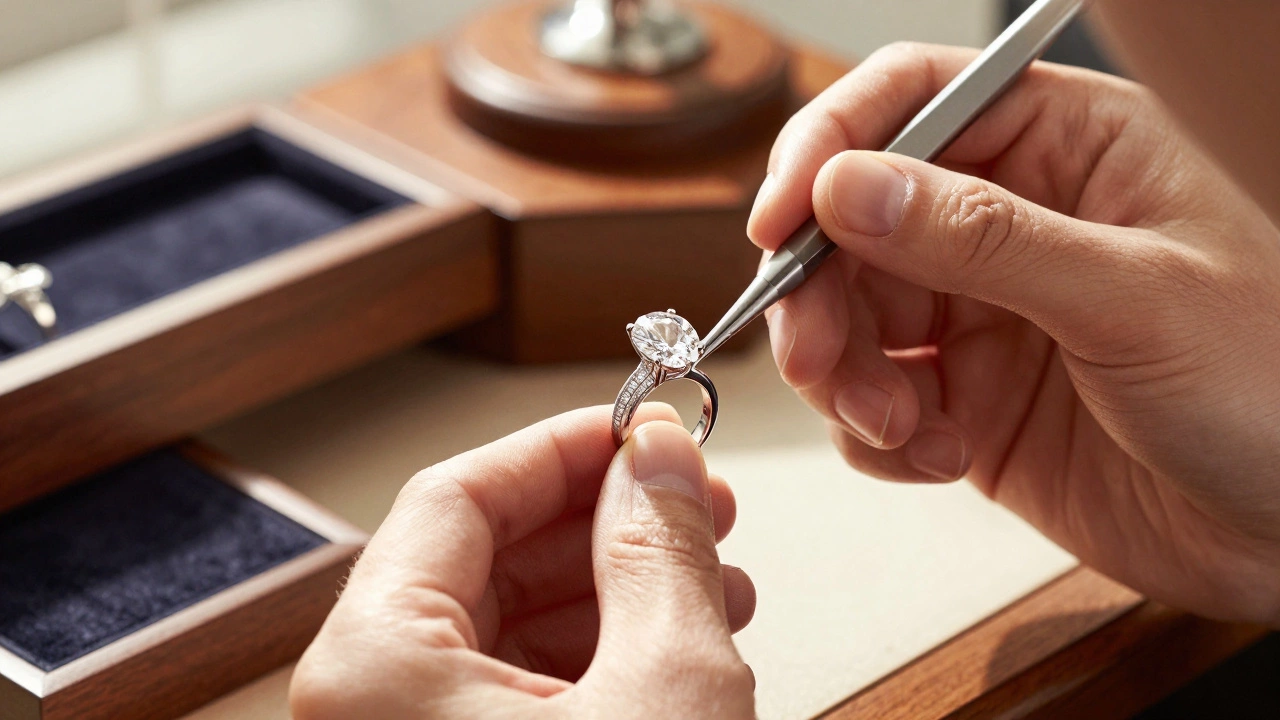
A common mistake is spending all $20,000 on the loose stone and forgetting that the diamond needs a home. A high-quality Platinum or 18k Gold band with side diamonds (pavé) can cost anywhere from $1,000 to $5,000.
If your total budget is $20,000, you should actually be shopping for a diamond in the $15,000 to $17,000 range. This leaves you breathing room for a custom setting that secures the stone properly. A huge diamond in a flimsy, cheap setting looks unbalanced and is a safety risk-you don't want a $15,000 stone falling out of a $200 mount.
The Shape Factor: Round vs. Fancy Cuts
The shape of the diamond changes how the budget translates to size. Round Brilliant diamonds are the most expensive per carat because they are the most demanded and waste the most raw diamond during cutting.
If you switch to "fancy cuts" like Oval Cut, Pear Cut, or Emerald Cut, your $20,000 will generally go further. An Oval cut, for instance, often looks larger than a Round cut of the same carat weight because it is elongated. If you want the appearance of a larger diamond without spending more, an Oval or Marquise cut is your best bet.
Is a $20,000 diamond considered "big"?
In the general population, yes. A 2-carat natural diamond or a 5-carat lab diamond is significantly larger than the average engagement ring. However, in the luxury market, it is a mid-to-high range budget that allows for high quality without reaching "investment grade" rare stones.
Should I prioritize clarity or color for a 2-carat stone?
Prioritize color up to a point. Most people can't see the difference between a D and a G color stone, but they can see a yellow tint in a K color stone. For clarity, as long as the stone is "eye-clean" (meaning you can't see flaws with your naked eye), you don't need to pay for a Flawless grade. A VS2 or SI1 often looks identical to a VVS1 to the untrained eye.
Will a lab-grown diamond look fake compared to a natural one?
No. Lab-grown diamonds have the same chemical structure, hardness, and refractive index as natural diamonds. Even a professional gemologist cannot tell them apart without specialized laboratory equipment. They sparkle and look exactly the same.
What is the best certification for a $20,000 diamond?
Stick to the GIA (Gemological Institute of America) or AGS (American Gem Society). These labs have the strictest grading standards. Some in-house certifications are "looser," meaning a stone graded as a "Color E" by a store might actually be a "Color G" by GIA standards.
Can I get a 3-carat natural diamond for $20,000?
It is possible, but you will have to make significant compromises. You would likely be looking at a diamond with lower clarity (SI1 or lower) or a noticeable color tint (I or J grade). It might also be a "fancy cut" like a Marquise or Pear, which are generally cheaper per carat than round diamonds.
Next Steps: How to Shop Your Budget
If you are ready to spend your $20,000, start by deciding on the "Vibe." Do you want the prestige of a natural stone, or the sheer size of a lab-grown one?
Once you've picked your path, create a "must-have" list. If you absolutely cannot stand a yellow tint, set your color minimum to G. If you want the stone to look massive, look at Ovals or Pears. Finally, always request the GIA certificate before paying. Never buy a high-ticket diamond based solely on the jeweler's word; the paper trail is what protects your investment.